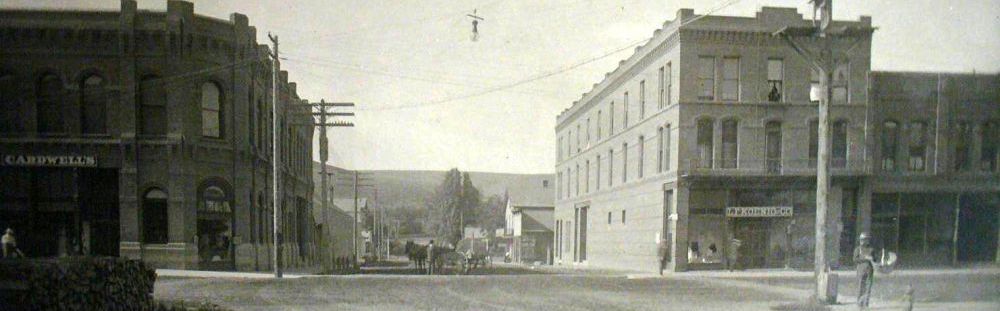
From an un-bylined front page article in the December 1, 1977, issue of the East Washingtonian newspaper.
County's name honors slain president
Last Tuesday, Nov. 29, [1977,] was the 96th anniversary of the separation of Garfield County from Columbia County.
The territorial legislature created the new county in 1881 and named it in honor of President James A. Garfield, who had been assassinated several months earlier.
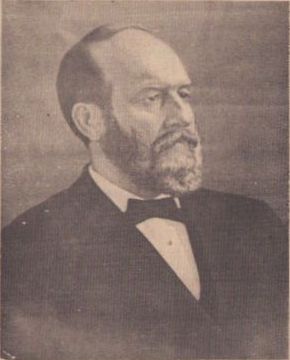
PRESIDENT JAMES GARFIELD
From painting in Garfield County Museum
Garfield was elected in November 1880 and took office in March 1881. He was shot by Charles J. Giteau, an unsuccessful office seeker, on July 2, 1881, in the Washington, D.C. railroad station. Garfield was about to attend the 25th reunion of his class at Williams College.
He suffered for 80 days, with doctors unable to locate the bullet lodged in his back. He was moved to a seaside cottage at Elberon, New Jersey, where he died on Sept. 19, 1881.
James Abram Garfield was born in Cuyahoga County, Ohio, on Nov. 19, 1831, the last President born in a log cabin. For a time, he was a teacher, before entering politics in Ohio.
He attained the rank of major general of volunteers in the Civil War, but in 1863 was elected to the House of Representatives.
His abilities in oratory and parliamentary procedures made him the leading Republican in the House. His record was marred by two questionable actions, one involving association with the Credit Mobilier scandal, during his career.
In 1880 he was elected to the U.S. Senate, but instead became the Presidential candidate on the 36th ballot as a result of a deadlock in the Republican convention. In the election, he easily beat General Winfield Scott Hancock, the Democratic candidate, although Garfield had only 7,000 more popular votes.
Vice President Chester Alan Arthur, a Vermont Republican, became President on Sept. 20, 1881, the day after Garfield's death. Arthur served as president for only the remaining 3 1/2 years of the term and was not renominated.
Meanwhile, in Garfield County, Washington Territory, Pataha City was established as the first county seat. Pataha City, Pomeroy and a third location—Mentor—vied for the permanent honor. Mentor, originally a Belfast overnight stop, was located across from McKeirnan Grade and was named in honor of Mentor, Ohio, a large town near the site of Garfield's birthplace. The townsite, three miles east of Pataha City, was apparently designed to split the vote in the eastern part of the county. . .which it possibly did, since Pomeroy won the January 1882 county seat election. The tactic led to a court battle, which Pomeroy eventually won.
E.T. Wilson and Dr. T.C. Frary published a paper in Pomeroy in November 1881, during the county seat campaign. This was discontinued at the end of the contest, but Wilson soon began publication of the Pomeroy Republican, now the East Washingtonian.
Until the loss of the county seat to Pomeroy, and the failure to obtain a rail connection (The first train arrived in Jan. 1886, but the track stopped near the eastern edge of Pomeroy) Pataha City and Pomeroy grew at about the same rate.
The site of Pataha City was taken up in 1861 by James Bowers, more than three years before J.M. Pomeroy arrived at the site now bearing his name. But Pomeroy became a town before Pataha City—B.B. Day opened a store in Pomeroy in the fall of 1877, and at about the same time W.C. Potter proposed that Mr. Pomeroy erect a sawmill there. Pomeroy began work immediately on laying out a town which was certified in the spring of 1878.
Pataha City was surveyed in June 1878, for A. J. Favor, who purchased the property in 1868, from J. Benjamin Norton, Bowers' son-in-law. At first the town was known as Favorsburg or Waterton, but the proprietor adopted the name Pataha City.
Both towns were following the lead of Columbia Center, the first town in the County, established in the fall of 1876.